
Drone Battery Chemistry: LFP vs Sodium-ion vs LiPo for UAV Applications

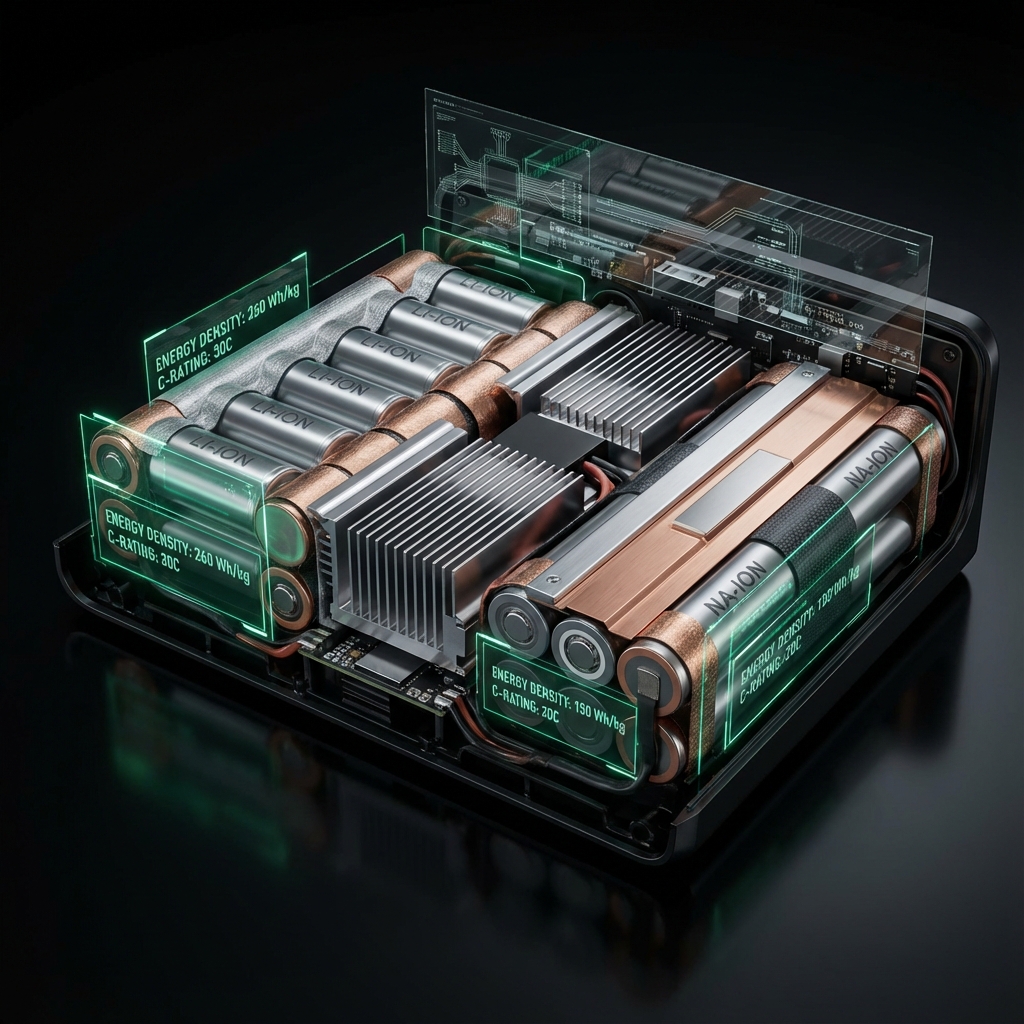
There's no single "best" drone battery chemistry. The optimal choice depends entirely on mission profile—and understanding why requires moving beyond marketing claims into the actual physics and engineering trade-offs.
This isn't about which chemistry wins some abstract competition. It's about matching power system characteristics to operational requirements: flight time versus payload capacity, discharge rates versus cycle life, thermal behavior versus operating environment.
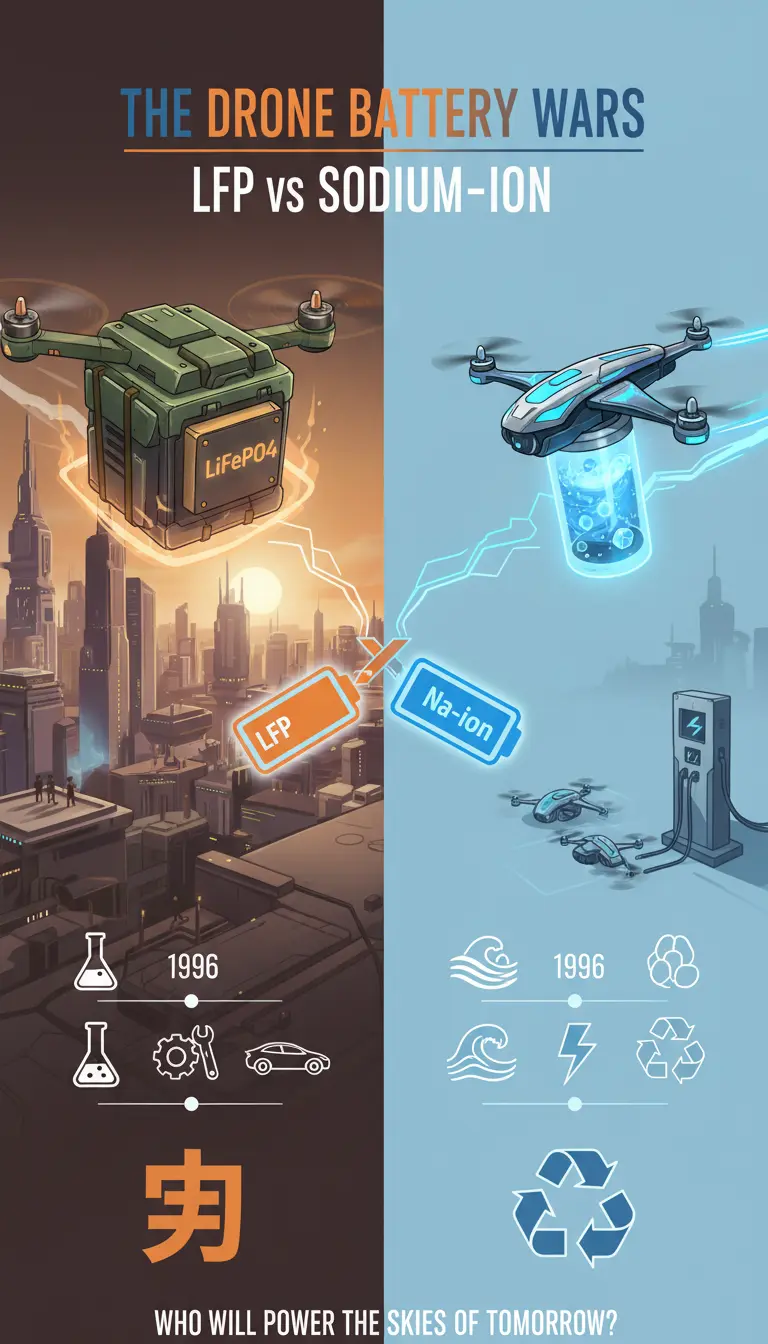
The Core Trade-off: Energy Density vs Everything Else
Drone applications expose the fundamental tension in battery design more acutely than ground vehicles. Every gram matters. Every watt-hour per kilogram translates directly to flight time or payload capacity.
| Chemistry | Energy Density | Discharge Rate | Cycle Life | Thermal Stability |
|---|---|---|---|---|
| LiPo (NMC/LCO) | 180-250 Wh/kg | 20-100C | 300-500 | Moderate |
| LFP | 150-200 Wh/kg | 3-5C typical | 2,000-6,000 | Excellent |
| Sodium-ion | 140-175 Wh/kg | High power capable | 3,000-5,000 | Excellent |
LiPo dominates consumer and racing drones for a reason: raw energy density and explosive discharge rates. A 100C-capable LiPo pack can deliver the instantaneous current needed for aggressive maneuvers. But that performance comes with trade-offs in safety, cycle life, and thermal management complexity.
LFP: The Safety-First Choice for Industrial Operations
Lithium Iron Phosphate batteries have carved out a specific niche in UAV applications where safety and longevity outweigh raw performance metrics.
Where LFP Excels
Industrial inspection over populated areas: When your drone operates above people, infrastructure, or sensitive facilities, the thermal runaway risk profile matters. LFP's olivine crystal structure remains stable up to 250-350°C—compared to NMC's 130-180°C threshold. The difference isn't academic; it's the margin between a controlled failure and a fire.
Fleet operations with high utilization: Commercial drone operators care about total cost of ownership, not just initial performance specs. LFP's 2,000-6,000 cycle life means five to ten times the operational lifespan of LiPo packs. For logistics or inspection fleets flying multiple sorties daily, that math dominates purchasing decisions.
Extreme temperature environments: LFP maintains stable performance across -20°C to +60°C operating ranges. More importantly, it degrades gracefully at temperature extremes rather than failing catastrophically.
Where LFP Falls Short
The physics are clear: LFP's lower energy density (150-200 Wh/kg versus LiPo's 180-250 Wh/kg) translates to heavier packs for equivalent capacity. For a multirotor where every gram reduces flight time, that penalty is significant.
More critically for high-performance applications: LFP's continuous discharge rates typically max out at 3-5C. Racing drones demanding 50-100C bursts simply can't use LFP chemistry. The power density gap is fundamental to the cathode material properties.
Sodium-ion: The Emerging Disruptor
Sodium-ion batteries represent the most significant chemistry shift since LFP's commercialization. The promise: lithium-like performance from an abundant, geopolitically uncomplicated element found in seawater.
Current State of the Technology
CATL's Naxtra brand targets 175 Wh/kg energy density—approaching LFP parity. Chinese manufacturer demonstrations have already shown sodium-ion batteries powering small drone flights successfully.
The technology's advantages align well with specific UAV requirements:
Superior cold-weather performance: Sodium-ion maintains capacity at temperatures where lithium chemistries suffer. CATL specifications claim operation from -40°C to +70°C—relevant for agricultural drones operating in northern climates or high-altitude inspection missions.
Deep discharge tolerance: Unlike lithium chemistries that degrade when discharged below 20% SOC, sodium-ion can safely discharge to 0V without permanent damage. For emergency landing scenarios, this characteristic provides genuine operational flexibility.
High power density potential: Current sodium-ion cells demonstrate 2-5 kW/kg power density—suggesting applications requiring burst power rather than sustained energy delivery.
The Reality Check
Despite the promise, sodium-ion faces practical barriers for mainstream UAV adoption:
Cost advantage has evaporated: As of 2025, sodium-ion has actually become more expensive than LFP per kWh—the opposite of initial projections. Manufacturing scale hasn't yet delivered expected cost reductions.
Energy density gap persists: At 140-175 Wh/kg, sodium-ion remains below LFP's current best-in-class offerings. For weight-critical drone applications, this deficit directly impacts mission capability.
Limited commercial availability: The supply chain for drone-optimized sodium-ion cells remains immature. LiPo and LFP have decades of application engineering; sodium-ion is still catching up.
Mission-Specific Chemistry Selection
The "best" chemistry depends entirely on operational requirements:
Racing and FPV
Chemistry: LiPo (NMC/LCO) remains unchallenged Why: 50-100C discharge rates enable the instantaneous power for aggressive maneuvers. Energy density maximizes power-to-weight ratio. Short flight times (3-5 minutes) make cycle life less critical.
Commercial Inspection and Surveying
Chemistry: LFP or high-quality Li-ion Why: Predictable performance across temperature ranges. Safety profile suitable for operations over infrastructure and populated areas. 30-60 minute flight times benefit from stable discharge characteristics. Fleet economics favor 2,000+ cycle life.
Heavy-Lift and Agricultural
Chemistry: High-capacity Li-ion or hybrid systems Why: Payload requirements demand maximum energy density. Agricultural drones need 30C+ discharge for 35kg+ takeoff weights. Some platforms combine batteries with fuel cells or generators for extended endurance.
eVTOL and Urban Air Mobility
Chemistry: Advanced Li-ion with thermal management, transitioning to solid-state Why: Aviation-grade requirements demand 300-600 Wh/kg for practical range. DO-160 certification requires extensive thermal and mechanical qualification. Safety margins must account for thermal runaway scenarios during high-power hover phases.
BMS Requirements for UAV Applications
Battery chemistry selection is only half the equation. The Battery Management System determines whether that chemistry performs to potential—or becomes a liability.
High-Rate Discharge Management
UAV BMS must handle discharge profiles that ground vehicle systems never encounter:
- Instantaneous current: Takeoff demands can exceed 100A for heavy-lift platforms
- Response time: Overcurrent protection must react within 50-150µs
- Continuous monitoring: Cell-level voltage sampling at 10-100Hz during flight
Thermal Management Integration
Drone batteries face unique thermal challenges:
- Limited cooling mass: No vehicle chassis to absorb heat
- Variable airflow: Thermal conditions change with flight phase and orientation
- Compact packaging: Thermal management hardware competes for mass budget
Advanced UAV BMS architectures incorporate:
- Active thermal throttling that reduces power before temperature limits
- Predictive thermal models that anticipate hotspots based on mission profile
- Temperature gradient monitoring across cell arrays
Flight Controller Integration
Modern UAV BMS communicates with flight controllers via CAN, UART, or SMBus protocols. Critical telemetry includes:
- Real-time SOC with flight time remaining estimates
- Cell-level voltage imbalance warnings
- Thermal status and any protective actions engaged
- Fault states requiring immediate landing
This integration enables intelligent power management: the flight controller can modify mission parameters based on actual battery state rather than conservative assumptions.
Aviation Certification Requirements
For eVTOL and certified UAV applications, battery systems must meet aviation-grade standards that far exceed consumer drone requirements.
DO-160 Environmental Testing
RTCA DO-160 specifies environmental qualification for aviation electronics:
- Temperature: -40°C to +85°C operational range
- Vibration: Qualification across aircraft-specific vibration profiles
- Shock: Survival of crash-pulse and handling loads
- Altitude: Performance verification at operational altitudes
Thermal Runaway Containment
EASA's MOC VTOL.2440 provides specific guidance on propulsion battery thermal runaway management for eVTOL aircraft. The standard requires:
- Demonstration that thermal runaway in one cell won't propagate to adjacent cells
- Time-to-propagation sufficient for emergency landing
- Containment of flames and ejecta within the battery enclosure
For aircraft carrying passengers, these requirements directly impact battery architecture—cell spacing, thermal barriers, and venting strategies all affect certification outcomes.
FAA Regulatory Evolution
The FAA's 2025 rules enabling powered-lift aircraft operations signal accelerating regulatory clarity. Battery certification requirements are still being finalized, but thermal runaway mitigation will be central to approval pathways.
Military and Tactical Requirements
Defense applications impose additional constraints through MIL-STD compliance:
Environmental Qualification (MIL-STD-810)
Military drone batteries must demonstrate:
- Operation from -40°C to +65°C
- Survival of 50,000g acceleration and 30,000 rpm spinning
- Resistance to salt fog, humidity, and altitude variations
- Shock and vibration profiles exceeding commercial standards
EMI/EMC Compliance (MIL-STD-461)
Electromagnetic compatibility ensures battery systems don't interfere with—or become vulnerable to—electronic warfare environments. BMS electronics must survive and function in contested electromagnetic environments.
Supply Chain Security
Beyond technical performance, military procurement increasingly scrutinizes supply chain origins. China's dominance in LFP production creates concerns for defense applications, driving interest in domestically-sourced alternatives including sodium-ion.
The Engineering Reality
Battery chemistry selection for UAV applications requires balancing competing requirements that have no universal optimum:
- Energy density determines flight time and payload capacity
- Power density enables aggressive maneuvers and heavy-lift takeoff
- Cycle life drives fleet economics and operational availability
- Safety profile constrains operating environments and certification pathways
- Thermal behavior affects reliability across mission conditions
- Cost influences commercial viability and fleet scaling
The trend lines are clear: LFP will continue dominating safety-critical industrial applications. Sodium-ion will find niches where its specific advantages—cold weather performance, deep discharge tolerance—outweigh current limitations. LiPo/Li-ion will remain essential for high-performance and aviation applications until solid-state alternatives mature.
At Wattality, we engineer aviation and UAV battery systems that match chemistry selection to mission requirements. Our BMS architectures provide the high-rate discharge management, thermal integration, and certification support that flight-critical applications demand—whether that's heavy-lift agricultural drones, industrial inspection platforms, or emerging eVTOL configurations.
The right battery isn't the one with the best specs on paper. It's the one engineered for your specific operational reality.
Sources:
- AYAA Technology - UAV Battery Complete Guide 2025
- Herewin Power - High Energy Density UAV Batteries
- MDPI - Critical Review on Battery System Reliability of Drone Systems
- The Air Current - Battery Certification Challenge for Electric Aviation
- SodiumBatteryHub - Sodium-ion vs LFP Key Differences
- Viable Power - Military Standards for Ruggedized Power Supplies
- JOUAV - Heavy Lift Drone Guide