
Edge AI Isn't Optional in Modern Battery Management

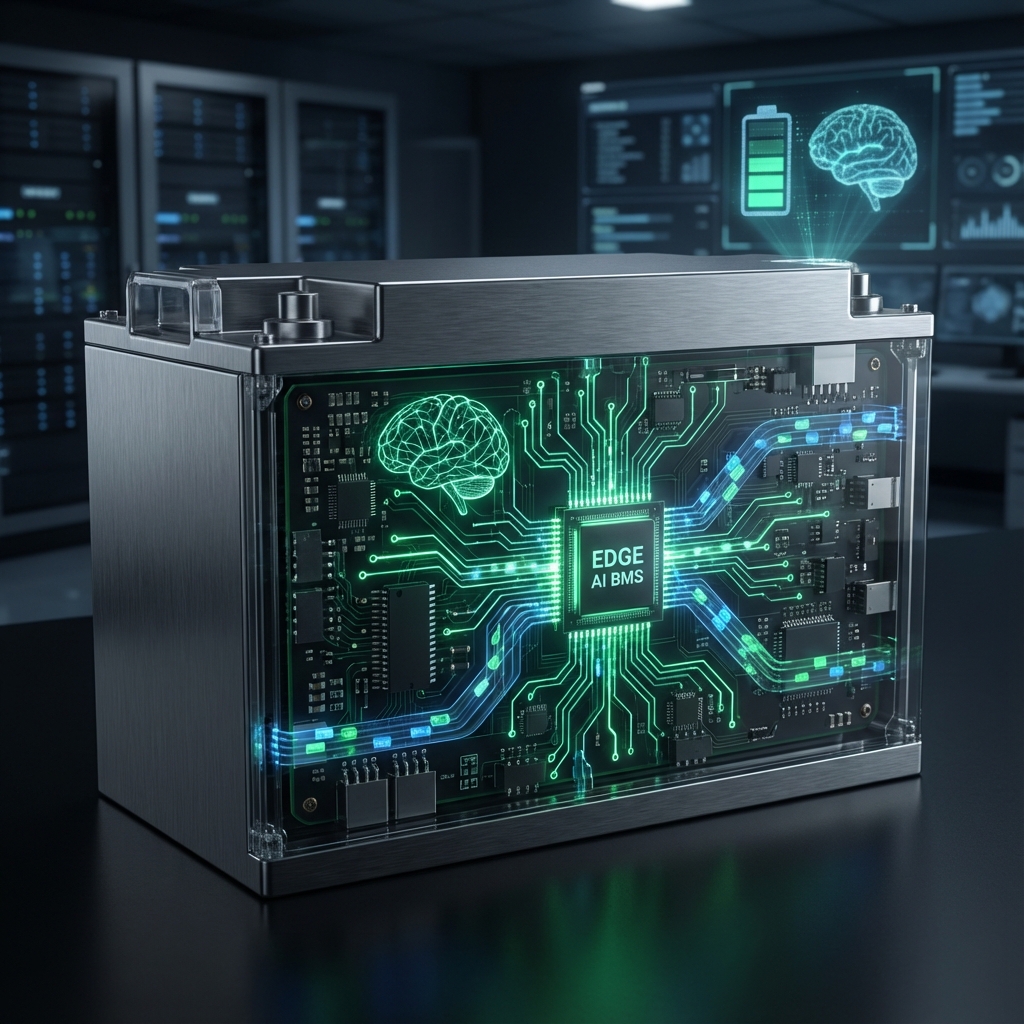
There's a pattern I've noticed in conversations about AI in battery management systems. Most of them circle around the same two topics: State of Charge estimation and State of Health prediction. And look, these matter. But if that's all we're talking about, we're missing the bigger picture of what edge intelligence actually enables in utility-scale energy storage.
The Real Latency Argument
Let me be precise about what edge AI actually solves, because I've seen this get confused.
The argument isn't that AI needs to detect and stop thermal runaway within 100 milliseconds of initiation—once a cell enters thermal runaway, you're managing propagation, not prevention. The value of edge AI is in the hours and minutes before anything goes wrong.
Modern thermal anomaly detection models—typically LSTM or GRU networks analyzing voltage derivatives, temperature gradients, and impedance shifts—can flag pre-runaway conditions hours in advance. But here's the thing: these models need continuous inference on streaming sensor data. They need to catch subtle deviations from baseline behavior that might indicate an SEI layer starting to degrade at 67-90°C, or gas generation patterns that precede venting.
This is where latency becomes real. Not "cloud is too slow to stop thermal runaway" but "continuous streaming to the cloud for real-time inference is neither economical nor reliable for safety-critical monitoring." If your thermal anomaly detection goes blind because your site lost connectivity for 20 minutes, that's an unacceptable risk profile for utility-scale infrastructure.
The millisecond response time argument does apply—but for actuation, not prediction. Once your edge model flags an anomaly, the decision to isolate a module or trigger pre-cooling needs to happen immediately, without a round trip to anywhere.
What Running AI Locally Actually Requires
When I say "edge AI," I mean inference happening on the actual hardware doing cell monitoring—not on a gateway, not on an edge server somewhere on site, but on the MCUs interfacing with your battery modules.
This is harder than it sounds for reasons that aren't immediately obvious. Traditional BMS microcontrollers weren't designed for neural network inference. You're constrained by SRAM limits, no dedicated accelerators, strict real-time requirements, and power budgets that don't have room for compute-heavy workloads.
The good news is twofold. First, silicon vendors have caught up. We're seeing MCUs with integrated Neural Processing Units—hardware accelerators specifically designed for edge inference—that make meaningful on-device AI practical without blowing your power budget. The price points have finally reached levels that make sense for volume deployment, not just R&D projects.
Second, and this is something I think about a lot: edge AI has the potential to reduce overall system cost, not increase it. If your models can infer internal cell temperature from voltage and current dynamics—which they can, with surprising accuracy—you might not need as many physical temperature sensors. If you can estimate impedance changes from operational data, you reduce dependence on dedicated measurement hardware. The BOM savings from intelligent sensing can offset the compute cost.
Beyond SOC and SOH: Where Edge AI Actually Adds Value
I'll be honest—I'm a bit tired of every AI-in-BMS discussion defaulting to state estimation. Yes, SOC accuracy matters. Yes, SOH tracking is important. But the interesting applications are broader.
- Real-Time Thermal Management: Not just monitoring temperatures, but actively predicting which modules are trending toward thermal stress and making pre-cooling decisions before thresholds are crossed. This is a control problem, not just an estimation problem, and it requires local intelligence because the decision loop needs to be fast and deterministic.
- Anomaly Detection at the Cell Level: Identifying the early signatures of a cell behaving differently from its neighbors—subtle capacity fade, unusual self-discharge, impedance drift—before it becomes a safety or reliability issue. This requires continuous comparison against baseline models, which is exactly the kind of workload that belongs at the edge.
That said, SOC accuracy does deserve a mention because the financial impact is more concrete than most people realize. Recent analysis from ACCURE and Modo Energy showed that LFP batteries—which now dominate utility-scale deployments—commonly see SOC estimation errors of 10-20% due to their flat voltage profiles. Eliminating that drift can boost revenue by up to 11%. For a 100 MW / 200 MWh system, that's roughly £420,000 per year. Not because your battery is better, but because you're not leaving capacity on the table during dispatch.
The revenue impact comes from something specific: in wholesale electricity markets, operators submit day-ahead and real-time bids based on their expected available capacity. If your SOC estimate says you have 15% less energy than you actually do, you're either bidding conservatively and missing opportunities, or you're hitting contractual delivery issues when the market expects you to perform. Accurate SOC translates directly to better market participation.
For what it's worth, we've also found that Kalman filter stages integrate naturally with learned models—using an LSTM output as a measurement input to a Kalman filter for SOC, or vice versa. The hybrid approach tends to be more robust than either method alone.
The Hybrid Architecture: What Lives Where
None of this means cloud infrastructure becomes irrelevant. Training sophisticated models requires computational resources that don't belong on an MCU. Fleet-wide pattern recognition, long-term degradation trending, and model retraining are inherently cloud functions.
The way we think about this split at Wattality involves three considerations: latency requirements, safety criticality, and cybersecurity exposure.
- Edge Domain: Anything safety-critical runs locally. Thermal anomaly detection, protection logic, cell isolation decisions—these don't touch the network. Anything requiring sub-second response runs locally. Active balancing decisions, thermal management actuation, real-time SOC for power dispatch.
- Cloud Domain: What benefits from fleet-level visibility and compute scale: predictive maintenance scheduling, warranty state tracking, capacity augmentation planning, operational analytics, financial optimization across the portfolio. Digital twin synchronization also lives here.
One pattern we've found valuable: shadow mode deployment for new models. Before a trained model goes into production control, it runs in parallel on the edge device, making "decisions" that get logged but don't actuate anything. You can validate model behavior against real operational data before it takes over. This is especially important when your models are making control decisions, not just estimations.
And cybersecurity matters more than most people acknowledge. Edge AI actually improves your security posture for safety-critical functions—the attack surface for something that never touches the network is fundamentally smaller than something dependent on cloud connectivity. For control functions specifically, the case for edge-only execution is as much about security as latency.
On Policy Constraints and Safety-Critical AI
There's a question that comes up whenever AI moves from estimation to control: how do you ensure the AI doesn't do something unsafe?
This is where the concept of a policy engine becomes essential. In safety-critical embedded systems, you don't let a neural network have unconstrained authority over actuation. The AI makes recommendations or predictions; a rule-based policy layer validates those outputs against hard constraints before anything happens. Think of it as a safety envelope that the learned model operates within.
This isn't unique to batteries—it's standard practice in automotive and aerospace. But it's worth being explicit about because the alternative—AI directly controlling safety-critical functions without constraint validation—isn't how responsible systems get built. Domain separation, constraint checking, and fallback to deterministic behavior when model outputs look suspicious. These principles apply whether you're doing this on an edge MCU or in the cloud.
Where the Industry Is Heading
I'm not frustrated by the pace of Edge AI adoption in battery storage—the industry is young, and these capabilities are genuinely difficult to implement well. What I do find limiting is how narrowly the conversation has focused on state estimation.
The next wave isn't about better SOC algorithms. It's about advanced sensing integration—hardware that can measure parameters traditional BMS couldn't access, like high-frequency impedance characteristics that reveal internal cell conditions in real-time. These measurements, combined with edge AI, will enable accuracy levels that make today's approaches look primitive.
We've started working with silicon partners on exactly this kind of integration. The accuracy improvements for SOH estimation alone are substantial. But more importantly, it opens up detection capabilities—early identification of lithium plating, SEI degradation, electrolyte decomposition—that simply weren't possible with voltage and temperature monitoring alone.
Companies focused purely on cloud-based AI for state estimation are going to find diminishing returns as sensing hardware improves. The value shifts to whoever can integrate advanced measurements with local intelligence at acceptable cost points. The sector is ready for capabilities that create differentiated value, not incremental improvements to commodity functions.
The Point
Edge AI in battery management isn't about latency for its own sake. It's about building systems that are reliable when connectivity isn't, secure because they minimize network exposure, responsive because control loops stay local, and economically optimized because accurate state estimation translates to revenue.
The systems we're deploying today will be in the field for a decade or more. The architecture decisions we make now—where intelligence lives, how safety constraints are enforced, what happens when the network goes dark—will determine whether those systems age gracefully or become technical debt.
The batteries aren't getting simpler. The grid isn't getting more forgiving. Edge AI isn't a feature you add—it's the foundation that makes everything else work.