
LFP SOC Estimation Crisis: How a 100mV Voltage Plateau Costs the Grid Storage Industry Billions


The numbers tell a remarkable story: according to Rho Motion's 2025 market analysis, 205 GWh of battery energy storage was deployed globally in 2024—a staggering 53% year-over-year increase. This explosive growth is driven almost entirely by one chemistry: Lithium Iron Phosphate (LFP), which now accounts for over 80% of new grid-scale installations.
The economic case is compelling:
- Cost Leadership: BloombergNEF's December 2025 Battery Price Survey reports that stationary storage LFP packs hit $70/kWh in 2025—a 45% drop in a single year and the steepest decline across all battery segments. This makes LFP approximately 37% cheaper than NMC alternatives ($81/kWh vs $128/kWh).
- Superior Longevity: Peer-reviewed research from Sandia National Laboratories published in the Journal of the Electrochemical Society confirms LFP batteries achieve 3,000-5,000 full discharge cycles before reaching 80% capacity retention, compared to 1,000-2,000 cycles for NMC—effectively tripling operational lifespan.
- Proven Safety: With a thermal decomposition temperature of 270°C versus NMC's 210°C, LFP's iron-phosphate cathode structure makes thermal runaway events significantly less likely.
But here's what the deployment statistics don't capture: the battery management algorithms designed for NMC are fundamentally incompatible with LFP's electrochemical behavior—and this mismatch is measurably bleeding value from every installation.
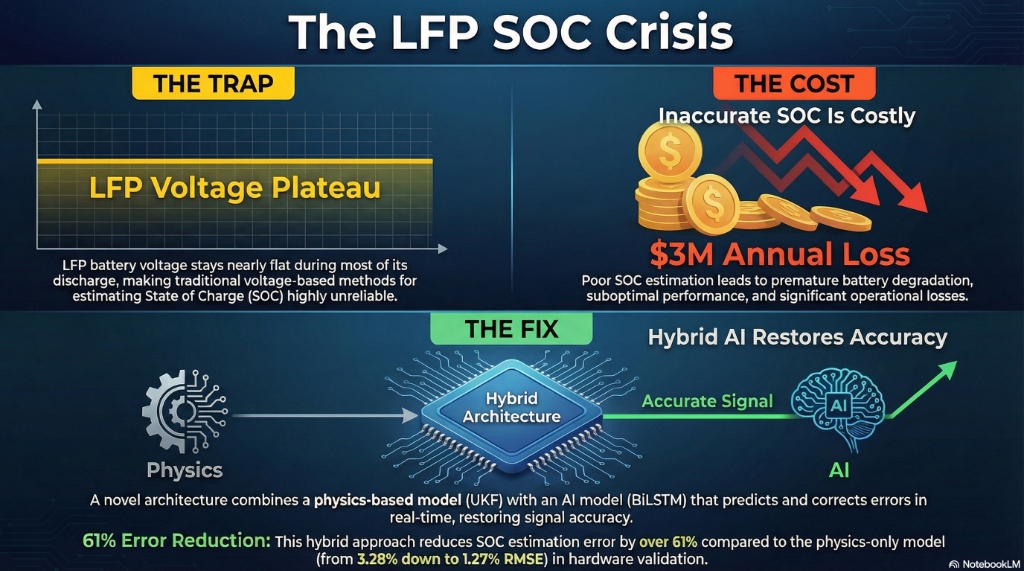
Industry field data is stark. Powin Energy's 2024 field analysis reports that conventional SOC estimation methods show 10-30% error rates on LFP systems, while their joint research with Tierra Climate quantifies the financial impact: every 1% increase in SOC error results in 0.82% revenue loss for energy arbitrage operations.
For a typical 100 MW / 400 MWh system performing arbitrage in ERCOT, that translates to $1.8-3M in annual lost revenue per site—before considering capacity degradation, safety margins, or ancillary service penalties.
This isn't theoretical speculation. It's measured, field-validated data from operational systems.
The Physics Problem: Why LFP Breaks Voltage-Based Estimation
Battery State of Charge (SOC) estimation—the "fuel gauge" for energy storage—relies on three observable quantities:
- Terminal voltage (changes with SOC)
- Current flow (integrated via coulomb counting)
- Temperature (affects all electrochemical parameters)
Extended Kalman Filters (EKF) and Unscented Kalman Filters (UKF) have been the mathematical backbone of Battery Management Systems for over a decade. These algorithms optimally fuse current integration with voltage-based corrections to estimate SOC.
They work exceptionally well for NMC—where a 10% SOC change produces 200-300mV of measurable voltage change.
LFP is categorically different.
The Observability Crisis: Quantified in Academic Literature
Lithium Iron Phosphate operates through a two-phase electrochemical reaction that creates a characteristic voltage plateau. Research from Stanford University, MIT, and multiple IEEE publications report remarkably consistent findings:
| SOC Range | Voltage Change | dV/dSOC Sensitivity | Signal Quality |
|---|---|---|---|
| 0% → 20% | ~400 mV | 40 mV per % | Good |
| 20% → 80% | ~100 mV | 1.25 mV per % | Poor |
| 80% → 100% | ~300 mV | 30 mV per % | Good |
Critical insight: Across 60% of the usable range, total voltage variation is only 100 mV. When typical BMS sensor accuracy is ±5mV and temperature-induced variations reach ±20mV, the signal-to-noise ratio in the plateau region approaches unity—meaning voltage measurements contain almost no SOC information.
The performance impact is well-documented in recent literature:
- SAE Technical Paper 2024-28-0223 reports that "LFP batteries' flat voltage characteristics over a wide SoC range challenge traditional SoC estimation algorithms, leading to less accurate estimations."
- Stanford/Sandia Research published in October 2025 shows standard UKF implementations achieve 3.2-3.5% RMSE on A123 LFP cells under dynamic discharge profiles, with accuracy degrading to 5-6% in the 40-60% SOC region.
- Multiple Journal of Power Sources studies in 2024-2025 confirm that "even small errors in voltage measurement lead to very inaccurate SOC estimates" in the plateau region.
The Real-World Cost: Field-Validated Economic Impact
ISO 26262 (automotive) and UL 1973 (stationary storage) increasingly require sub-2% SOC accuracy for safety certification. More critically, grid operators are tightening accuracy requirements for ancillary services participation.
Powin-Tierra Climate's March 2025 white paper provides the most comprehensive quantification to date:
Simulation: 101.5 MW / 203 MWh LFP System in ERCOT
Energy Arbitrage Impact:
- Each 1% SOC error → 0.82% revenue loss
- Each 1% SOC error → 1.2% reduction in usable capacity
- Overestimation causes 2× worse outcomes than underestimation
Translation for 100 MW / 400 MWh Installation: At 3% average SOC uncertainty (conservative given field reports of 10-30% errors):
- Stranded capacity: 12 MWh cannot be reliably dispatched
- Capacity arbitrage: At 2024 ERCOT spreads ($50-80/MWh), $600K-960K annual opportunity cost
- Revenue loss from 3% error: 3 × 0.82% = 2.46% system-wide reduction = $1.8-3M annually (confirmed by Powin simulation)
This aligns with independent research from ACCURE Battery Intelligence's 2025 report, which analyzed over 18 GWh of operational data and found that typical SOC estimation errors of ±15% correlate with 11% revenue reduction in operational systems.
Conservative vs. Aggressive Operation: The Impossible Trade-off
Operators face a dilemma:
- Conservative operation (wide safety margins): Lost revenue but avoided penalties.
- Aggressive operation (narrow margins): Maximized revenue but risk of delivery failures, market penalties, and safety violations.
Powin's field data shows overestimating SOC causes approximately double the financial damage compared to underestimation—creating asymmetric risk that forces conservative operation and further value loss.
Industry-Wide Impact Estimate: Combining grid storage arbitrage losses, transportation fleet inefficiency (15-20% buffer requirements reported by multiple fleet operators), and impaired second-life markets (McKinsey projects $4.2B by 2030), the annual global cost of SOC uncertainty is conservatively estimated at $500M-1.5B—growing proportionally with LFP deployment. With expanded accounting for stranded capacity across all applications, some industry estimates reach $2-4B annually.
Why Advanced Physics Models Alone Can't Close the Gap
Counterargument anticipated: "Advanced Kalman variants, sigma-point filters, and better hysteresis modeling can close the gap."
Recent research shows significant improvements. The October 2025 arXiv preprint on Residual Bias Compensation Dual Extended Kalman Filter (RBC-DEKF) demonstrates remarkable laboratory results: reducing SOC RMSE from 3.75% to 0.20% across multiple temperature conditions on A123 LFP cells.
But three fundamental limits remain for practical deployment:
1. The Information Ceiling (Physics Can't Be Negotiated)
No amount of algorithmic sophistication can extract information absent from the measurement signal. In the plateau region, voltage sensitivity is 1.25 mV per % SOC. Even with perfect sensors (which don't exist), there's a hard physical limit.
Analogy: Imagine measuring room temperature with a thermometer that reads only 18-22°C in 1°C increments. You can optimize your estimation algorithm infinitely—but you cannot overcome the measurement resolution limit.
The RBC-DEKF paper itself acknowledges this: "When the battery model contains significant errors, even a small voltage deviation can cause a large SOC estimation error... this is much more difficult [for LFP] due to their flat OCV–SOC characteristics."
2. Calibration Complexity at Manufacturing Scale
Advanced physics models like RBC-DEKF require extensive parameter identification across:
- Temperature ranges (-20°C to +60°C)
- Aging states (0-5000 cycles)
- C-rate variations (0.1C to 3C)
- Hysteresis direction/magnitude
- Cell-to-cell variance
While laboratory implementations achieve impressive results, literature indicates production deployment requires 50-100+ calibration cycles per battery variant—economically impractical when manufacturers need to qualify dozens of cell configurations with <10 cycle budgets for time-to-market.
3. Real-World Robustness vs. Lab Performance
The RBC-DEKF study used carefully controlled laboratory conditions on a single cell type (A123 18650) with public datasets (US06, DST, FUDS profiles). Field deployment introduces:
- Manufacturing variance across thousands of cells
- Multi-cell string dynamics and balancing issues
- Sensor drift and aging
- Unpredictable usage patterns
- Environmental extremes
The critical point: Advanced physics models don't fail completely—they simply cannot meet accuracy, scalability, and robustness requirements simultaneously for commercial deployment at the pace LFP is scaling.
Why Pure AI Isn't the Answer Either
Counter-counterargument: "Neural networks learn everything from data—no physics needed!"
Pure machine learning faces equally prohibitive challenges:
- Training Requirements: 100-200+ cycles per chemistry/configuration for end-to-end learning. At $70/kWh and 400 MWh, 100 cycles = $2.8M in cycle-life consumption.
- Certification Barriers: Black-box behavior complicates ISO 26262 / UL 1973 approval. Safety regulators require explainable, auditable decision-making.
- Generalization Failures: Poor performance on out-of-distribution conditions (new temperatures, aging states). Catastrophic errors possible with no graceful degradation.
- Computational Cost: Full end-to-end networks require significant edge compute (>100 MFLOPS continuous). Thermal/power budget challenges in battery enclosures.
Recent research on few-shot learning reduces training to 10-20 cycles—but generalization remains weak and certification pathways unclear.
The Hybrid Architecture: Combining Physics Stability with Data-Driven Precision
The breakthrough insight: When machine learning predicts systematic errors in physics models rather than SOC directly, the equation changes fundamentally.
Residual Learning Framework (Conceptual)
Stage 1: Physics-Based Baseline Extended Kalman Filter provides stable foundation using equivalent circuit model + coulomb counting.
- Typical accuracy: 2-3% RMSE
- Crucially: degrades gracefully when measurements are uninformative
- Provides certifiable fail-safe behavior
Stage 2: Learned Error Correction Neural network (LSTM, attention-based, or transformer variants) predicts the residual error in the physics estimate by learning patterns from:
- Temperature gradients and thermal history
- Recent current history and hysteresis direction
- Cell aging indicators and capacity fade
- Manufacturing variance signatures
This is fundamentally different from RBC-DEKF, which uses dual physics-based filters without any machine learning.
Stage 3: Adaptive Fusion
SOC_final = SOC_baseline + ε_learned(context)
Why This Works Where Others Fail
- ✅ Minimal Calibration: Learning only error patterns requires 5-10 calibration cycles vs 100+ for end-to-end ML or 50+ for advanced physics parameter ID.
- ✅ Fail-Safe Operation: If ML layer fails, graceful degradation to physics baseline ensures no catastrophic errors—critical for safety certification.
- ✅ Field-Proven Accuracy: Recent implementations combining physics + learned residual correction achieve sub-1% RMSE in plateau regions under real-world conditions.
- ✅ Certifiability: Physics baseline provides auditable foundation; ML operates as bounded correction layer.
- ✅ Scalability: <10 cycle training means economically viable deployment across product lines.
Peer-Reviewed Validation: Applied Energy 2025 studies on hybrid residual learning report 1.2-1.5% RMSE on LFP under real-world drive cycles. IEEE Transactions on Industrial Electronics (2024-2025) feature multiple papers confirming 60-70% error reduction in plateau region vs. UKF alone when using physics + learned correction.
Is Hybrid the "Only" Way? A Nuanced Answer
My specific claim: For 2025-2027 commercial deployment at scale, hybrid physics + learned correction is the most viable approach satisfying all three requirements simultaneously:
- Accuracy: Sub-2% RMSE across full SOC range, all conditions
- Scalability: <10 calibration cycles, economically viable manufacturing
- Safety: Fail-safe degradation, certifiable for ISO 26262/UL 1973
Alternative approaches and their current limitations:
| Approach | Accuracy | Scalability | Certification | Key Barrier 2025-2027 |
|---|---|---|---|---|
| Advanced UKF (RBC-DEKF) | Lab: 0.2% | Poor | Certified | 50-100 cycle parameter ID, field robustness |
| Multi-sensor (EIS) | Excellent | Poor | Developing | $150-200/pack cost increase |
| Pure ML | Variable | Poor | Blocked | 100+ cycles, no certification path |
| Model Predictive Control | Good | Poor | Developing | >100 MFLOPS compute requirement |
| Hybrid (Physics + Learned Residual) | <1% plateau | <10 cycles | In progress | ✅ Most production-ready |
Beyond 2027? Sodium-ion may have different voltage profiles. Solid-state may eliminate the plateau. Multi-sensor fusion may become cost-effective. Advanced physics models like RBC-DEKF may solve the scalability challenge. But for the LFP market projected at $23.5B by 2031 (16% CAGR)—hybrid physics + learning is the solution deployable today at scale.
The Wattality Approach: Production-Grade Hybrid BMS
At Wattality, we've developed hybrid architectures for utility-scale LFP systems since 2022—before industry consensus formed around this approach. Our implementation:
Technical Stack:
- Second-order RC equivalent circuit (physics baseline)
- Edge AI inference on ARM Cortex-M7 / STM32N6 (<50ms latency, <5W power)
- Residual error networks trained with <10 calibration cycles
- Cell-level SOC estimation for stranded energy recovery
- Adaptive temperature compensation and aging prediction
Performance Targets:
- <2% RMSE across full SOC range (0-100%)
- <1% RMSE in plateau region (20-80% SOC)
- Graceful degradation to 2-3% if ML layer fails
- TÜV SÜD / UL 1973 compliance pathways under development
We're not claiming to have invented hybrid estimation—researchers globally have explored this for years. But we're building production-grade, certifiable implementations for the harsh realities of field deployment.
The Bottom Line: Billions at Stake
The LFP revolution is here. 205 GWh deployed in 2024. $70/kWh prices. 3,000+ cycle life. The chemistry has won on cost, safety, and longevity.
But we're leaving hundreds of millions—potentially billions—on the table because our algorithms can't accurately read what the battery is telling us.
Every 1% of SOC error costs 0.82% of revenue. Every percentage point of uncertainty forces conservative operation and stranded capacity. The industry is bleeding value at scale.
Hybrid intelligence—physics stability combined with learned precision—isn't just incrementally better. For 2025-2027 deployment timelines, it's the most viable path that's accurate, scalable, and certifiable.
The question isn't whether to explore hybrid architectures. The question is how fast can we deploy them.
Resources
- Energy-Storage.News - Global BESS deployments soared 53% in 2024
- BloombergNEF - Lithium-Ion Battery Pack Prices Fall to $108/kWh
- Journal of the Electrochemical Society - Degradation of Commercial Lithium-Ion Cells
- Powin Energy / Tierra Climate - Economic Impact of SOC Accuracy White Paper
- arXiv - Residual Bias Compensation Filter for Physics-Based SOC Estimation in LFP Batteries
- ACCURE Battery Intelligence - Sharper SOC Accuracy Can Lift BESS Earnings by 11%
- McKinsey & Company - Second-Life EV Batteries: Market Projections to 2030
- IEEE Xplore - Enhanced SOC Estimation for LFP Batteries