
UL 9540A Testing Explained: The Complete Guide for BESS Manufacturers

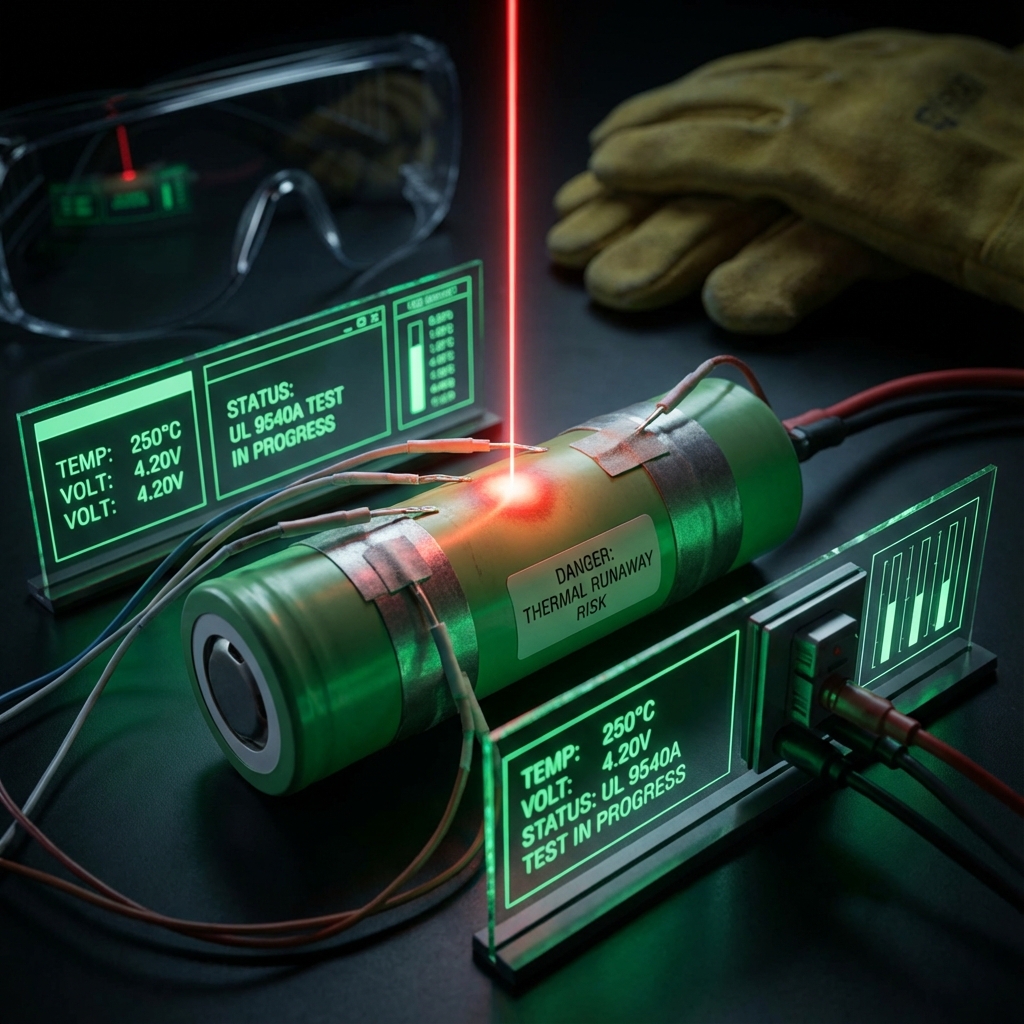
Here's a confusion I encounter regularly: manufacturers talking about their "UL 9540A certification." There's no such thing. UL 9540A is a test method that generates data—it doesn't certify anything. That distinction matters more than semantics, and getting it wrong can derail permitting timelines and project approvals.
This guide breaks down what UL 9540A actually tests, how the four-level cascade works, what changed in the 2025 edition, and why NFPA 855's new large-scale fire testing requirements are reshaping how BESS projects get approved.
UL 9540 vs UL 9540A: The Critical Distinction
UL 9540 is a safety certification standard—the industry benchmark ensuring energy storage systems work safely. It covers mechanical, electrical, and environmental testing across the complete system. Products receive UL 9540 certification after meeting comprehensive requirements for construction, system safety, and performance.
UL 9540A is a test method for evaluating thermal runaway fire propagation. It generates data on how batteries behave under extreme stress conditions. The test doesn't produce a pass/fail verdict—it produces information that informs system design, installation decisions, and regulatory approvals.
Think of UL 9540A as one critical hurdle within the larger race of achieving UL 9540 certification. Since 2020, a UL 9540A test report has been required for UL 9540 certification of higher-risk and larger ESS systems. In practice, most jurisdictions now require both: UL 9540 certification AND UL 9540A test reports before granting project approval.
The key insight: UL 9540A data doesn't just satisfy a regulatory checkbox—it directly influences spacing requirements, ventilation design, suppression system selection, and emergency response protocols.
The Four-Level Testing Cascade
UL 9540A employs a graduated testing methodology, starting from individual cells and scaling to complete installed systems. At each level, if the system demonstrates safe behavior, further testing may not be required.
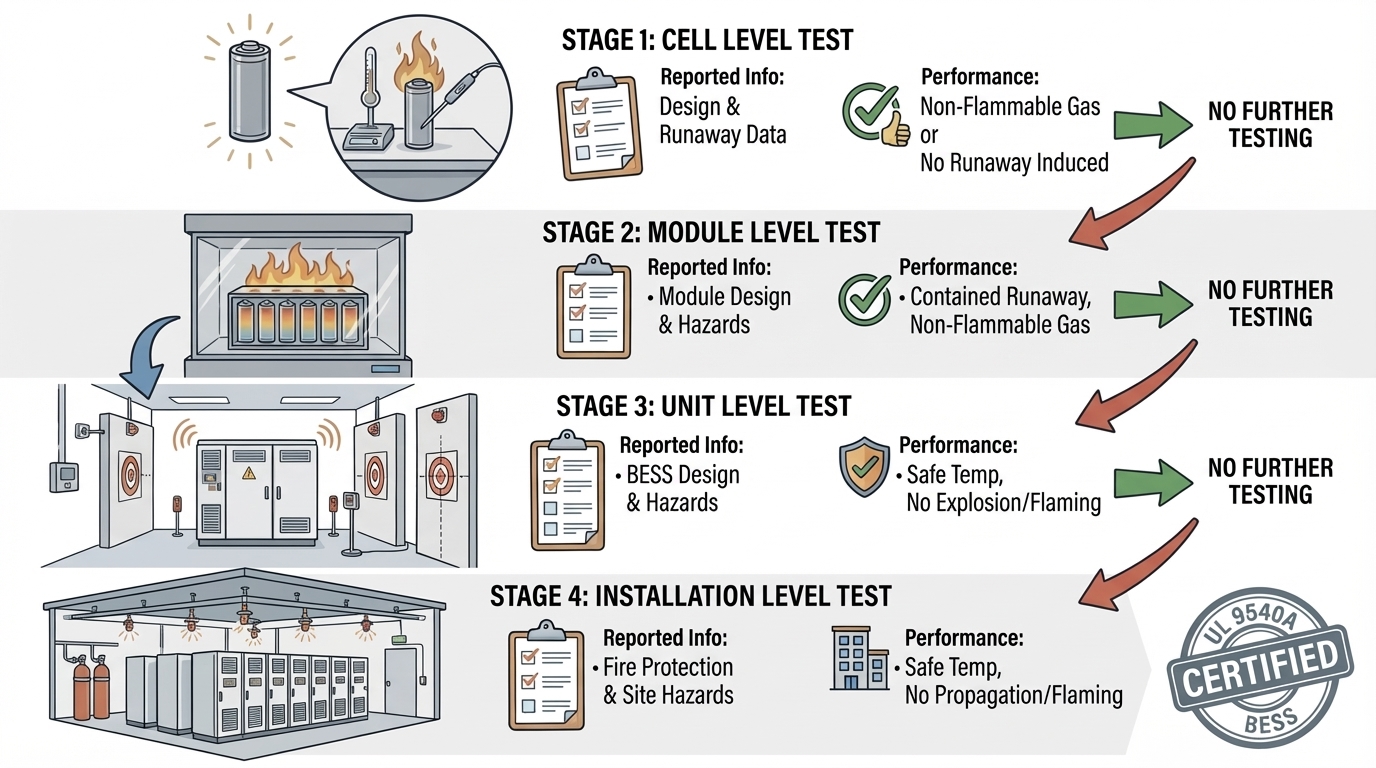
Level 1: Cell Level Test
Individual battery cells are deliberately forced into thermal runaway inside a pressure vessel. The test analyzes:
- Gas composition: Identifying hydrogen, carbon monoxide, hydrogen fluoride, and hydrocarbons released during failure
- Lower Flammability Limit (LFL): Determining when released gases become explosive
- Maximum explosion pressure (Pmax): Quantifying worst-case pressure buildup
- Burning velocity: Measuring how fast flames propagate through vented gases
If cell-level testing shows non-flammable gas release or no induced runaway in adjacent cells, testing can conclude here. This rarely happens with lithium-ion chemistries.
Level 2: Module Level Test
Groups of cells assembled into modules undergo testing under a smoke collection hood. The same thermal runaway initiation method forces failure, and engineers measure:
- Whether thermal runaway propagates from the initiating cell to neighbors
- Heat release rates during propagation
- Gas composition and generation rates at module scale
- Time to propagation between cells
The 2025 edition adds a critical update: module casing temperature limits are now part of the performance criteria.
Level 3: Unit Level Test
The complete BESS unit—including all internal safety mechanisms—faces scrutiny. Testing evaluates:
- Fire spread rate within the unit
- Convective and chemical heat release rates
- Gas release rates and composition via FTIR analysis
- Wall temperatures and heat flux measurements
- Effectiveness of internal thermal barriers and isolation systems
For residential BESS, the 2025 edition replaces the NFPA 286 fire test room with an instrumented wall, streamlining testing while maintaining rigor.
Level 4: Installation Level Test
The complete system in its installed configuration undergoes testing with fire protection systems active. This level validates:
- Fire suppression system effectiveness
- Gas containment and venting adequacy
- Spacing requirements between units
- Protection of egress routes for emergency responders
Installation-level results directly inform AHJ decisions on ventilation, spacing, and suppression requirements for specific project sites.
UL 9540A:2025 Edition—Key Changes
Published March 12, 2025, the fifth edition introduces significant updates that affect testing procedures and reporting requirements.
Thermal Runaway Propagation Time (TRPT)
The most significant conceptual addition. TRPT establishes a formula:
TRPT ≥ T, where T = fire response time + personnel evacuation time
For grid-scale systems, this typically means TRPT ≥ 30 minutes—ensuring fire suppression systems can activate and personnel can evacuate before propagation becomes uncontrollable.
This isn't just a metric; it's a design constraint. Systems that propagate too quickly may require redesign regardless of other test results.
Expanded Chemistry Coverage
The 2025 edition introduces test methods for:
- High-temperature batteries: Sodium-ion and semi-solid lithium systems behave differently than standard lithium-ion
- Lead-acid and nickel-cadmium: Established chemistries now have formalized test protocols
- Flow batteries: Refined methodology addressing aqueous electrolyte characteristics
This expansion matters because emerging chemistries entering the market—particularly sodium-ion—need standardized safety validation.
Enhanced Reporting Requirements
Test reports must now include:
- Sensitivity analysis of thermal runaway trigger conditions
- Propagation differences across ambient temperatures (20°C to 50°C)
- Impact of cycling degradation (e.g., after 5,000 cycles) on safety behavior
This addresses a real gap: batteries age, and safety characteristics change. A cell that passes testing at beginning-of-life may behave differently after years of operation.
Digital Twin Integration
The standard now encourages CFD (Computational Fluid Dynamics) simulations to predict propagation paths before physical testing. Simulation data calibrated against actual test results can significantly reduce testing costs for large-scale systems while maintaining safety confidence.
NFPA 855 and Large-Scale Fire Testing
The 2026 edition of NFPA 855 fundamentally changes how large BESS projects approach fire safety validation.
New Annex G.11 Requirements
NFPA 855:2026 introduces Annex G.11, which for the first time:
- Separates LSFT from UL 9540A installation-level testing: These are now distinct requirements
- Requires testing of multiple interconnected racks: Not just single units in isolation
- Focuses on adjacent unit impact: Verifying that complete combustion of one enclosure won't trigger thermal runaway in neighboring units
- Moves LSFT from optional to expected: Particularly for large and clustered installations
What LSFT Actually Tests
Large-Scale Fire Testing verifies that recommended spacing between units prevents fire propagation even under worst-case conditions. The test:
- Intentionally ignites a full BESS enclosure with suppression disabled
- Allows complete combustion
- Monitors adjacent units for thermal runaway initiation
- Validates manufacturer-recommended spacing
Results are reviewed by registered design professionals who verify applicability for anticipated site wind conditions and specific installation configurations.
Timeline for Compliance
UL 9540A is evolving to address LSFT criteria. A dedicated task group within the UL 9540A Technical Committee has been developing expanded test methods. The comment period closed August 2025, with changes expected in early 2026.
For manufacturers and project developers, this means planning testing programs that anticipate both current UL 9540A requirements and emerging LSFT protocols.
Testing Costs and Timeline
Full UL 9540 certification typically takes 3-12 months depending on system complexity. UL 9540A testing specifically can require several months, with costs and timelines affected by multiple factors.
Cost Breakdown by Level
Testing costs scale significantly with level:
| Test Level | Typical Cost Range | Duration | What's Tested |
|---|---|---|---|
| Cell Level | $15,000 - $30,000 | 2-4 weeks | Gas composition, LFL, Pmax |
| Module Level | $25,000 - $50,000 | 3-6 weeks | Propagation, heat release |
| Unit Level | $40,000 - $80,000 | 4-8 weeks | System behavior, gas release |
| Installation Level | $60,000 - $150,000+ | 6-12 weeks | Full configuration with suppression |
Total four-level testing typically ranges from $50,000 to $200,000+, with costs varying based on:
- Battery chemistry: Novel chemistries require additional test development
- System size: Larger units require larger test chambers and more instrumentation
- Laboratory selection: Pricing varies between accredited labs (UL Solutions, TÜV SÜD, Intertek)
- Expedited timelines: Rush testing adds premium costs
Hidden Costs to Consider
Beyond direct testing fees:
- Sample destruction: Test cells and modules are consumed during testing
- Shipping and logistics: Hazmat shipping for battery samples adds cost
- Engineering support: Interpreting results and implementing design changes
- Re-testing: If initial results require design modifications, additional test cycles add time and cost
Strategic Recommendations
Start early: In the BESS market, time-to-market is competitive advantage. Beginning UL 9540A testing during product development—not after—prevents costly delays.
Design for testing: Systems designed with thermal barriers, gas venting, and isolation features that support favorable UL 9540A results have smoother paths to market.
Understand the data's purpose: UL 9540A results inform more than certification. They shape installation requirements, insurance terms, and AHJ approvals. Test data that demonstrates safety margins can reduce project-specific engineering costs.
Monitor standard evolution: The 2025 edition is current, but LSFT requirements are still developing. Staying ahead of regulatory evolution prevents rework.
Chemistry-Specific Testing Considerations
Different battery chemistries present distinct challenges in UL 9540A testing. Understanding these differences helps manufacturers anticipate testing outcomes and design accordingly.
Lithium-Ion (LFP, NMC, NCA)
Most UL 9540A experience comes from lithium-ion testing. Key considerations:
- LFP (Lithium Iron Phosphate): Higher thermal stability (250-350°C runaway threshold) typically results in slower propagation and lower gas generation. Often achieves favorable results at earlier test levels.
- NMC/NCA: Lower thermal runaway thresholds (130-200°C) and higher energy density create more aggressive test conditions. Thermal barrier design becomes critical.
- Gas composition varies by chemistry: LFP generates approximately 86% less hydrogen fluoride than NMC—significant for gas detection system design and first responder safety protocols.
Emerging Chemistries
The 2025 edition specifically addresses:
- Sodium-ion: Different thermal behavior than lithium-ion. Generally considered inherently safer, but standardized test data is still accumulating.
- Semi-solid lithium: Novel electrolyte behavior requires adapted test protocols.
- Flow batteries: Aqueous electrolytes don't exhibit thermal runaway in the traditional sense, but thermal management and containment remain important.
For manufacturers working with emerging chemistries, early engagement with testing laboratories helps establish appropriate test parameters before formal testing begins.
Global Adoption and Industry Impact
UL 9540A is mandatory in the US and Canada, but its reach extends further:
- Singapore, Malaysia, Victoria (Australia): Reference UL 9540A in installation regulations
- China (GB/T36276): The 2025 UL 9540A edition aligns more closely with Chinese standards, facilitating international expansion
- Europe: While IEC standards dominate, UL 9540A data increasingly supports project approvals
For manufacturers targeting global markets, UL 9540A testing provides foundational safety data applicable across multiple regulatory frameworks.
What This Means for Your Projects
The relationship between UL 9540A testing, UL 9540 certification, and NFPA 855 compliance is tightening. For utility-scale and data center BESS projects, the requirements are clear:
- UL 9540A test reports are baseline documentation
- Installation-level testing validates site-specific configurations
- LSFT will increasingly be required for large and clustered systems
- Test data directly influences spacing, ventilation, and suppression design
At Wattality, we engineer battery management systems that integrate with safety testing requirements from the architecture phase. Our systems provide the cell-level monitoring, thermal management, and gas detection integration that support favorable UL 9540A outcomes—and the documentation capabilities that streamline regulatory approval.
Understanding safety testing isn't just about compliance. It's about designing systems that perform safely throughout their operational life, with data that proves it.
Sources:
- UL Solutions - UL 9540A Test Method
- UL Solutions - Introduction to Revisions of UL 9540A:2025
- UL Solutions - Large-Scale Fire Testing and UL 9540A
- Mayfield Renewables - UL 9540 and 9540A Explained
- Jensen Hughes - UL 9540A vs. C800: How LSFT is Reshaping BESS Design
- Telgian - NFPA 855 Changes in the 2026 Edition