Why battery management needs intelligence at the edge
Safety, control and security in battery storage depend on decisions made next to the cell. What belongs at the edge, what stays in the cloud, and why.
- Published
- Updated
- 5 min read
- 5 min read

Edge AI in battery management systems (BMS) processes cell data locally to support state-of-charge (SOC) and state-of-health (SOH) estimation, thermal management and anomaly detection. Local execution keeps monitoring running during connection outages and reduces control-loop latency.
Where latency really matters
Local anomaly detection tracks signs that precede thermal runaway. Once a cell enters thermal runaway, the goal is to limit propagation.
Thermal anomaly models, typically recurrent neural networks such as LSTM or GRU, read voltage derivatives, temperature gradients and impedance shifts. They can flag pre-runaway conditions well in advance. To do that, they need continuous inference on streaming sensor data. They look for small deviations from baseline behavior: the early breakdown of the solid electrolyte interphase (SEI) layer at elevated temperature, or the gas generation patterns that come before venting.
Running anomaly detection on site keeps monitoring active during connection outages. Processing sensor data locally reduces the cost of continuous cloud data transfer and dependence on connectivity.
Once the local model flags an anomaly, actions such as isolating a module or starting pre-cooling require millisecond response. Keeping the decision loop local allows these actions to be applied quickly.
What running AI locally requires
Here, "edge AI" means inference on the microcontrollers (MCUs) connected to the battery modules.
This is harder than it sounds. Traditional BMS microcontrollers were not designed for neural network inference. They have limited SRAM, no dedicated accelerators, strict real-time deadlines and power budgets with no room for heavy compute.
Two developments change the picture.
Microcontrollers with integrated neural processing units (NPUs), hardware accelerators built for on-device inference, make local AI practical within a tight power budget. Their cost now suits volume production.
Edge AI can lower total system cost. A model that estimates internal cell temperature from voltage and current dynamics can reduce the number of physical temperature sensors a pack needs. A model that tracks impedance changes from operating data reduces dependence on dedicated measurement hardware. The bill-of-materials (BOM) savings from intelligent sensing can offset the cost of the compute.
Thermal management and anomaly detection
Local inference also supports thermal management and anomaly detection:
- Real-time thermal management. Predicting which modules are trending toward thermal stress and making pre-cooling decisions before thresholds are crossed. Pre-cooling decisions require a fast, deterministic local control loop.
- Cell-level anomaly detection. Finding the early signs that a cell behaves differently from its neighbors (slight capacity fade, unusual self-discharge, impedance drift) before it becomes a safety or reliability issue. This needs continuous comparison against baseline models, exactly the kind of workload that belongs at the edge.
SOC accuracy still deserves attention, because its financial effect is concrete. Lithium iron phosphate (LFP) cells, now common in grid-scale storage, have a very flat voltage curve across most of their charge range. Voltage tells little about the charge level in that flat region, so SOC estimates drift, and the error can grow large between calibrations.
The cost shows up in the market. In wholesale electricity markets, operators bid day-ahead and in real time based on the capacity they expect to have. If the SOC estimate shows less energy than the battery really holds, the operator bids conservatively and leaves revenue unearned. If it shows more, the operator risks missing a delivery commitment. Accurate SOC turns directly into better market participation: the battery is the same, but its real capacity is put to use.
A common way to raise SOC accuracy is to combine methods. A Kalman filter can take a learned model's output as a measurement input, or a learned model can refine the filter's estimate. The hybrid tends to be more robust than either method alone.
The hybrid architecture: what runs where
The cloud brings together the compute needed for model training and data from across the fleet. It handles fleet-wide pattern recognition, long-term degradation analysis and model retraining.
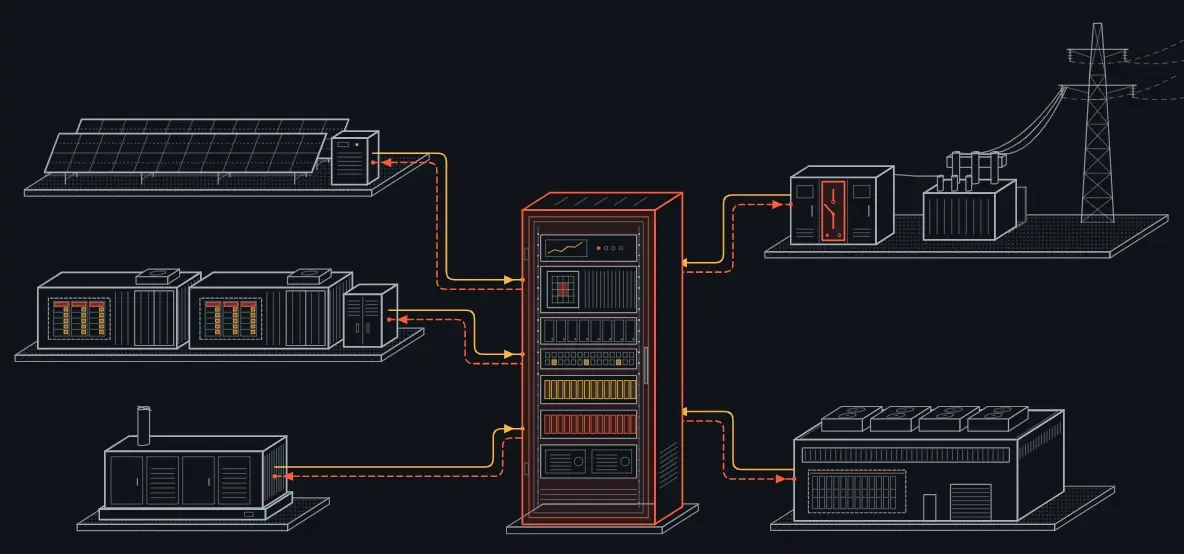
The architecture we design for splits the work on three criteria: latency, safety criticality and cybersecurity exposure.
- Edge domain. Everything safety-critical runs locally: thermal anomaly detection, protection logic, cell isolation decisions. These never touch the network. Everything that needs sub-second response also runs locally: active balancing, thermal management actuation, real-time SOC for power dispatch.
- Cloud domain. Everything that gains from fleet-level visibility and compute scale: predictive maintenance scheduling, warranty tracking, capacity augmentation planning, operational analytics and financial optimization across a portfolio. Keeping each asset's digital model in sync also lives here, which is the role of fleet analytics.
In this split, decisions are made at the edge and the cloud develops the models behind them. Protection continues if the connection drops, and raw data can stay on site.
New models need a safe path into production. A well-established practice is shadow mode. Before a trained model takes over control, it runs in parallel on the edge device and makes "decisions" that are logged but never actuate anything. Its behavior is checked against real operating data first. This validation is especially important for models that make control decisions.
Local execution also strengthens cybersecurity. A function that never touches the network has a much smaller attack surface than one that depends on cloud connectivity. For control functions, the case for edge execution is as much about security as about latency.
Policy constraints for safety-critical AI
When AI moves from estimation to control, one question comes first: how do you make sure it never does something unsafe?
The answer is a policy engine. In safety-critical embedded systems, a neural network never holds unconstrained authority over actuation. The model makes recommendations or predictions; a rule-based policy layer checks each output against hard constraints before anything happens. The learned model works inside a safety envelope.
This is established practice in automotive and aerospace engineering, and it applies to batteries just as well. The principles are domain separation, constraint checking, and a fallback to deterministic behavior when a model's output looks wrong. They hold whether the model runs on an edge MCU or in the cloud.
Where the field is heading
Advanced sensing hardware measures the cell's impedance spectrum across frequencies to provide information about its internal resistance and chemical state. Combined with edge AI, this kind of cell-level measurement raises the accuracy of SOH estimation. It also enables early detection of lithium plating, SEI degradation and electrolyte decomposition, conditions that voltage and temperature monitoring alone cannot reveal.
As sensing hardware improves, the value moves to systems that combine advanced measurement with local intelligence at an acceptable cost. Measurement flows up from the cell; decisions flow down to the field. That is the principle behind our technology.
The point
Local control keeps protection running during connection outages and allows decisions to be applied quickly. State-estimation accuracy also determines the capacity an operator can use and commit.
Where control runs, how safety constraints are enforced and how connection outages are handled matter throughout a storage system's operating life. In the architecture we design for, control runs next to the cell; the cloud supports model training and fleet analysis.
- Edge AI
- Battery storage
- BMS
- Safety
- Control